


The 9th General Assembly in Palermo and Online brought together around 114 participants, with about 50 attending in person and 64 joining online. Members took part in two panel sessions combining strategic reflections and project updates. The meeting also included the presentation of Steering Committee candidates, with elections taking place in the following days and closing on 19 September.
 Two panel sessions showcased both strategic perspectives and project updates from the Life Cycle Initiative community. The first explored “what’s missing and what’s next” for mainstreaming life cycle approaches, with insights from policy, implementation, industry, and methods highlighting priorities such as harmonisation, reliable data, capacity building, actionable insights for decision-makers, and integration of social dimensions. The second provided project updates on the Global LCA Platform, UNEP’s textiles workstream, and the Biogenic Carbon Project.
The General Assembly was chaired by Archana Datta (UNEP, Life Cycle Initiative Secretariat) and kicked off a panel moderated by Claudia Peña (EPD Latin America) with Mauro Cordella (European Commission, DG Environment), Pippa Notten (The Green House), Jitti Mungkalasiri (Thailand’s National Science and Technology Development Agency), and Marisa Vieira (PRé Sustainability).
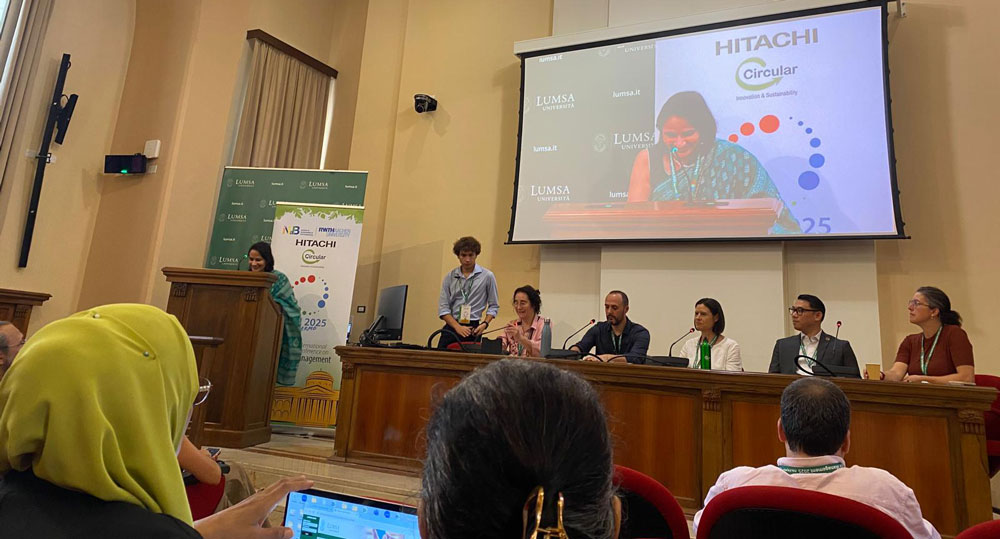 The discussion centred on “what’s missing and what’s next” for mainstreaming life cycle approaches. From a policy standpoint, Mauro highlighted that LCA is straightforward in preparatory phases (impact assessments, option evaluation) but harder when regulating markets (e.g., carbon/environmental footprints for products such as batteries and PV). Success requires reliable, comparable data, harmonised rules, product-specific measures, transparent stakeholder processes, and pragmatic simplification without sacrificing scientific coherence. He stressed international collaboration, broader involvement of industry and governments, and statistically robust benchmarks.
From an implementation and capacity perspective, Jitti described Thailand’s decade-long strategy: securing high-level policy buy-in (including green public procurement), scaling product carbon footprinting (>10,000 products), extending beyond environment ministries to energy and transport, and embedding LCA expertise. He underscored three enablers—basic infrastructures, strong collaboration (including export-oriented industry), and human development through universities and research institutes—and the need to close regional capability gaps while ensuring platform interoperability.
From industry and methods, Marisa pointed to two persistent hurdles: (1) streamlining data collection (APIs between enterprise systems and LCA tools) and (2) getting actionable insights to decision-makers (design, procurement) via simpler dashboards and role-appropriate interfaces. She called for configurable archetype models to expand data coverage, clearer consumer communication (labels/ratings), and a modern, widely adopted open data format to unlock interoperability across software. Pippa cautioned against over-simplification that erodes decision support, urging fit-for-purpose methods that show value beyond compliance. She emphasised hands-on training with locally relevant data and argued that integrating social dimensions alongside environmental ones is essential for uptake, especially in the Global South.
Closing reflections converged on four priorities: harmonisation, high-quality data, infrastructure and human capacity, and moving from vision to implementation through collective action across academia, government, industry, and the Life Cycle Initiative community.
A second panel discussion moderated by François Saunier (Deputy Executive Director, CIRAIG), brought together Ming Xu (Tsinghua University), Claudia Giacovelli (UNEP) and Archana Datta (UNEP) to provide quick updates on three key Life Cycle Initiative workstreams.
- Ming Xu outlined the Global LCA Platform’s path from the July 10–11 Milan workshop to four working groups (data standards and methodology; data quality, review and curation; governance and stakeholder engagement; technical development and infrastructure). Next steps: mid-September 2025 kickoff meetings, establishment of the working groups by end-September, Terms of Reference by mid-October, a blueprint outline by end-October, and a Blueprint v1 by year-end.
- Claudia Giacovelli reported on UNEP’s textiles workstream integrating life cycle approaches across the value chain, with capacity building and pilots in Kenya, Tunisia, South Africa, India and Indonesia; priorities include expanding locally relevant environmental and social LCI data, harmonising simplified tools, and using LCA to drive the sector’s shift from linear to circular models.
- Archana Datta updated the Biogenic Carbon Project: launched in 2024 through a consensus-based process, briefly paused to recalibrate facilitation given strong, diverse positions, now set to relaunch in October 2025 with added road-testing, aiming for stakeholder-informed recommendations by end-2026, and currently welcoming both expert participation and funding support.
Members are invited to engage in the Global LCA Platform working groups, collaborate on textile data and tool harmonisation, and contribute expertise and resources to the Biogenic Carbon Project; details will follow via the newsletter and LinkedIn.
LC Initiative Steering Committee elections
 Each year, we hold elections for three new Steering Committee members, and this year, our congratulations go to the following newly elected Steering Committee members:
- Government: Brazilian Institute for Science and Technology Information – Ibict, Thiago Rodrigues (Latin America and Caribbean)
- Business: Edge Impact, Jonas Bengtsson (Asia-Pacific)
- Science and Civil Society: Swedish Life Cycle Center (SLCC), Anna Wikström (Europe)


